

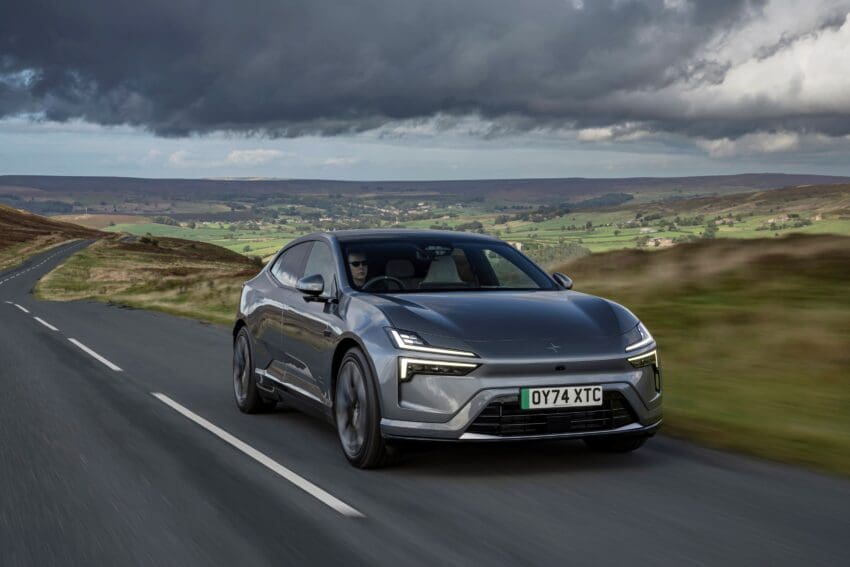
Polestar 4 review: Polished performance tripped up by tech
The Polestar 4 blends great looks, dynamic driving and impressive EV performance but is let down by screen-based silliness
Polestar recently unveiled its new Polestar 5 – an 871bhp grand touring behemoth that cemented the fact that the brand is definitely not just the “sporty Volvo lot” anymore.
But the signs have been there for a while, not least with this, the Polestar 4. While the Polestar 3 still has echoes of the Volvo EX90 to which it’s related, the Polestar 4 is entirely its own thing, built on a completely different platform and with far sportier ambitions.
It’s a performance-tinged SUV-coupe that sits in an odd space where everything from the Porsche Macan Electric, Tesla Model Y and Audi Q6 e-tron to the Kia EV6 GT and BYD Sealion 7 could be considered rivals.
But is it any good? Let’s find out.
Design, interior and technology
The Polestar 4 is marketed as an SUV-coupe – a phrase that conjures up images of bloated monstrosities such as the BMW X6 and Mercedes GLE Coupe. But Polestar’s designers have done a brilliant job of making the 4 look less like a fastback on stilts and more like a properly resolved sporty saloon.


Its proportions do a great job of disguising the fact that this is a pretty big car. The 4’s whole design flows seamlessly in one piece from the angled bonnet line with its slim two-section lights, to the solid sloping rear deck and the full-width slimline lightbar.
A lot has been made of the fact the Polestar 4 lacks a rear window but, frankly, it’s not a massive deal. The digital rear view mirror does do some very peculiar things to perspective, so can’t be relied upon for reversing manoeuvres, but that’s what the main reversing camera is for. In general day-to-day driving, the screen-as-a-mirror works fine for tracking what’s happening behind you.
Polestar says that it did away with the rear window so it could deliver the swoopy roofline without compromising rear passenger space. And it certainly does that. It’s a little dark, but the rear of the cabin is remarkably spacious and comfortable. There’s plenty of headroom and space to stretch out, even with a taller driver up front, and those in the back get their own air conditioning zone and heated reclining seats.
Up front there’s acres of space and a crisp and modern design. There’s a very Scandinavian simplicity to everything, with minimal clutter, clean lines and extensive use of just a few materials – including sustainably sourced leather – which bring a premium feel befitting the car’s premium positioning. Chrome highlights on switchgear help lighten the feel but I think I’d go for the cream interior rather than my test car’s black upholstery.

The simplicity creates a soothing, calming atmosphere that lasts just until you start using the 15.4-inch touchscreen, through which absolutely everything is controlled – from your wing mirrors and suspension settings to your glovebox and boot opening.
Polestar might be a Swedish brand but the influence of its Chinese owner shines through here, where “technology” takes precedence over intuitive, safe use.
The screen itself is sharp and responsive but it’s a mess of ill-considered shortcuts and tiles. The map permanently occupies half the available space of the home screen and there are a bunch of default shortcut controls for options such as media, phone and “ambience”. Above those you can dock up to six of your chosen shortcuts, but not functions like suspension or steering – things you might actually want to adjust on the move.
You have to delve into the secondary layer for those, and it is a monochromatic mess of tiles and more menus that are almost impossible to navigate whilst driving. Some of the steering wheel buttons can be set up as further shortcuts but as these are unmarked and change function depending on which menu you happen to be in, it’s hardly an instinctive setup.


The whole shambles is all the more frustrating because it’s wrapped in such excellent surroundings. It’s like designing your dream Scandinavian home then letting your dog do its business in the entrance hall.
Battery, motor and performance
Once you get going, most of the awkwardness of the screen is forgotten as the Polestar 4 delivers on the brand’s ambition to be a premium performance marque.
I drove the long range dual motor variant, which comes with a 94kWh battery and two motors delivering all-wheel drive and a potent 536bhp/506lb ft.
That allows this refined five-seater to get from 0-62mph in just 3.7 seconds and provides a seemingly endless well of torque that delivers immediate shove no matter what speed you’re doing.
In any situation, the Polestar 4 feels muscular and responsive with smooth, punchy power delivery controlled by a well modulated throttle. There’s a “range” mode that dulls the throttle slightly but doesn’t blunt performance entirely.

You can specify an additional Performance pack which brings a sportier chassis tune, Brembo brakes and some cosmetic upgrades but even in standard guise, the 4 matches its power with a pleasingly engaging drive.
It’s not a sports car, but it is sporty. In standard mode the steering is a bit light but the “firm” setting does help a bit and it’s accurate and communicative enough to let you enjoy the car and push on. You’re always aware of the car’s weight but it corners with confidence and composure.
You can also choose between three settings for the air suspension. Even in “firm” it’s still fairly pliant and absorbent. You don’t get any nasty shocks but on the UK’s shoddy roads, the middle “nimble” setting is perhaps the best option.
Like the steering and throttle there aren’t huge leaps between each suspension mode and most owners will probably find a combination of the three elements that suits them and stick with that. That’s just as well given how much of a faff it is to adjust any of them via the screen on the move.

The 94kWh battery should be good for 367 miles, according to official testing. Efficiency is quoted at between 2.87m/kWh and 3.34m/kWh. My test car’s long-term figure was just north of 3.1m/kWh and in the real world with some spirited driving, the trip computer was estimating just shy of 300 miles.
That’s respectable and backed up by 200kW peak DC charging which means a 10-80% top-up in 30 minutes.
Price and specification
The Polestar 4 range starts at £55,000 for the long range single motor model. That gets the same 94kWh battery but deletes the front motor, so has to make do with 268bhp.
The dual motor version tested here starts at £67,000 and the only differences between the two trims is that extra motor and the inclusion of the £5,000 Plus pack as a standard feature.
All Polestar 4s get a premium spec with 20-inch alloy wheels, LED lights, a powered tailgate, flush-fitting door handles, heated front seats, two-zone climate control, digital instruments and a head-up display plus the Android Automotive-powered 15.4-inch touchscreen. There’s also a heat pump, 360-degree parking camera and a Scrabble board’s worth of driver assistance including adaptive cruise control and lane keep assist. The Bridge of Weir leather upholstery is a £3,100 upgrade over the vegan-friendly Bio-Tech standard.


The Plus pack adds climate control and heated seats for the rear passengers, adaptive LED headlights, a 12-speaker Harman Kardon stereo and 22kW AC charging. There is a Pilot pack which adds more complex driver assistance, and the Pro pack, which brings bigger wheels and cosmetic upgrades.
Verdict
The Polestar 4 is a great car in virtually every way.
It looks great, is brilliant to drive, comfortable and refined, with strong range and charging speeds. But it’s let down by an overly complicated and ill-considered UX that makes every simple operation frustrating.
As an owner you’ll get used to some of its foibles, but “getting used to it” doesn’t seem good enough, especially given the car’s other qualities.

Polestar 4 long range dual motor
- Price: £67,000 (£71,500 as tested)
- Powertrain: Two-motor, all-wheel-drive
- Battery: 94kWh
- Power: 536bhp
- Torque: 506lb ft
- Top speed: 124mph
- 0-62mph: 3.7 seconds
- Range: 367 miles
- Consumption: 2.87m/kWh-3.34m/kWh
- Charging: up to 200kW