

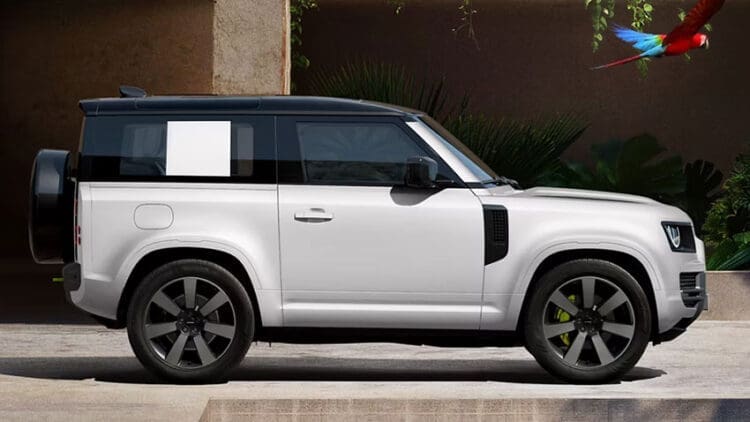
Jaguar Land Rover has slammed the brakes on an all-electric Defender. Bosses have placed a two-year pause on the planned full redesign of the standard model, a shake-up that pushes the battery version of Britain’s most successful 4×4 into the 2030s.
The generational redesign had been expected in 2028-29, although no date was ever formally announced. Sources familiar with the situation say it will now slip into the next decade, leaving the electric off-roader field to Mercedes-Benz and its G 580 with EQ Technology while Land Rover’s own electric Range Rover, which made its public debut at Goodwood, carries the electric torch for the group.
Not everything is on hold. Plans for JLR’s “baby Defender”, the smaller electric model expected to start at around £40,000, will still go ahead.
The reason for the wait on the full-size car is an old one. JLR has previously said the architecture of the Defender, relaunched in late 2019, makes it too difficult to package an electric vehicle battery. Customers were told they would have to wait for the fully redesigned version. Now they will be waiting rather longer.
JLR said: “Defender is one of JLR’s greatest success stories. With more than 75 years of heritage, purpose and proven capability, it is our class-leading bestseller due to continued strong global demand and enduring brand appeal.”
Success, tariffs and a cost squeeze
Industry sources say the move comes with new chief executive PB Balaji under pressure to cut costs after a tumultuous 18 months at the Tata Motors-owned business.
The company is understood to have told staff that the pause is down to the current car’s success rather than any loss of faith in it. JLR sells 110,000 Defenders a year, almost a third of the 350,000 cars it shifted in its financial year to March 2026.
Then there is Washington. President Trump’s tariffs have hit JLR hard, and while Sir Keir Starmer negotiated a deal to cut import taxes on UK-built vehicles to 10 per cent, Balaji is understood to have conceded that even that increase cannot be passed on to American buyers.
North America is JLR’s biggest single market at 28 per cent of sales, which explains the announcement earlier this month that Defender production will begin in the US in partnership with Vauxhall owner Stellantis. American-bound Defenders are currently designed and engineered in the UK, with engines built in Wolverhampton, but final assembly happens in Slovakia. Exporting from the EU attracts a 15 per cent US tariff rather than 10 per cent.
The timing at home is awkward too. The delay lands as ministers consult on watering down the UK’s EV sales targets. Hatched in the final throes of the Starmer administration, Andy Burnham has unveiled a consultation on cutting the required share of EVs among new car sales to as low as 50 per cent by 2030, down from the current 80 per cent goal, after the government conceded that driver demand is lower than anticipated.
Ministers insist the 2030 ban on new petrol and diesel cars stays. The industry is sceptical, not least because meeting it could require half of all cars sold to be hybrids, and the government has yet to define what counts as a hybrid.


