
EU sets course for new small EV class
European lawmakers have confirmed plans for a new class of ultra-compact European-built electric cars.
The proposed class will set strict limits on vehicle dimensions and offer car makers extra incentives to sell smaller, cheaper models.
The European Commission – responsible for drafting new legislation – is currently in discussion with European car makers about the class but has confirmed initial details.
Loosely inspired by Japan’s long-standing kei car class, the new M1E category will sit beneath the current M1 class, which covers regular passenger cars, and above the L7E quadricycle class that includes cars like the Citroen Ami.
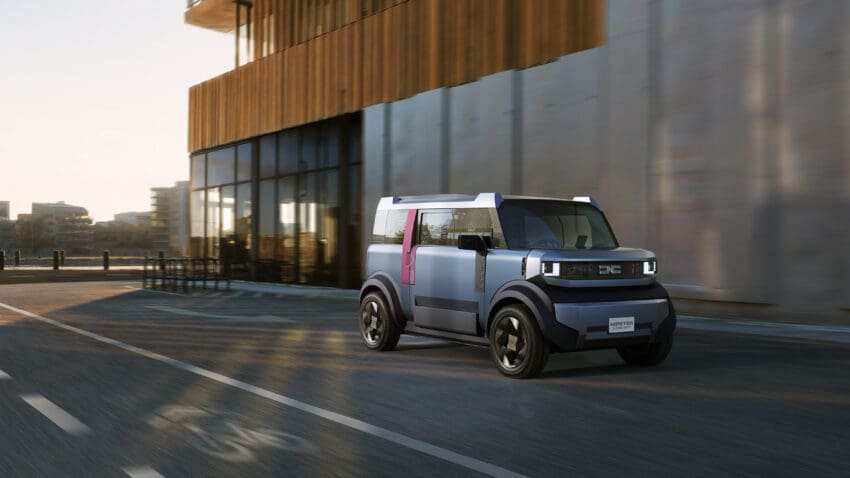
Vehicles in the M1E class will have to be less than 4.2 metres long. That’s significantly larger than the kei car limit and bigger than concept models from the likes of Dacia, which were believed to hint at future “E car” projects.
Several current EV models will qualify for the class based on size – including the Renault 4 and 5, and the Cupra Raval/Volkswagen ID. Polo twins. However, it’s not clear if there may be other technical restrictions on the new class.


The EC said it aimed to set requirements for the class for 10 years to give manufacturers certainty for product planning.
To encourage car makers to build eligible cars in Europe the proposals include plans for “super credits” to help car makers hit emissions targets up to 2034. These would give 1.3 credits for every European-built M1E car sold, rather than the standard one credit per vehicle. These credits could then be used to offset carbon emissions from other vehicles as car makers aim to hit the recently watered-down CO2 targets for Europe.
The credits would promote the manufacture of smaller EVs in Europe and notably exclude cars like the super-cheap Dacia Spring and Leapmotor T03, which are built in China.
The EC has suggested that creating a clearly defined segment could also help individual countries set up incentive schemes ranging from subsidies and tax breaks to size-based parking fees or access to priority traffic lanes.
After focusing on larger SUVs for their early EVs, many car makers are now turning their attention to smaller, cheaper models. Renault will launch its Twingo next year and VW’s A-segment ID.1 is also expected to debut in the coming 12 months. Stellantis brand Peugeot, Citroen and Fiat have hinted at new entry-level models. And Smart has confirmed a direct successor to its tiny Fortwo in the shape of the #2, although this could be built in China.
Although any new European car class will have no direct impact on UK vehicle rules, it is likely that models built in Europe for Europe could also be sold here in future.