
Clocking up the miles on an electric Grand Tour of Switzerland
As the Grand Tour of Switzerland celebrates its 10th year, we venture from lakeside to mountaintop at the wheel of an all-electric Cupra
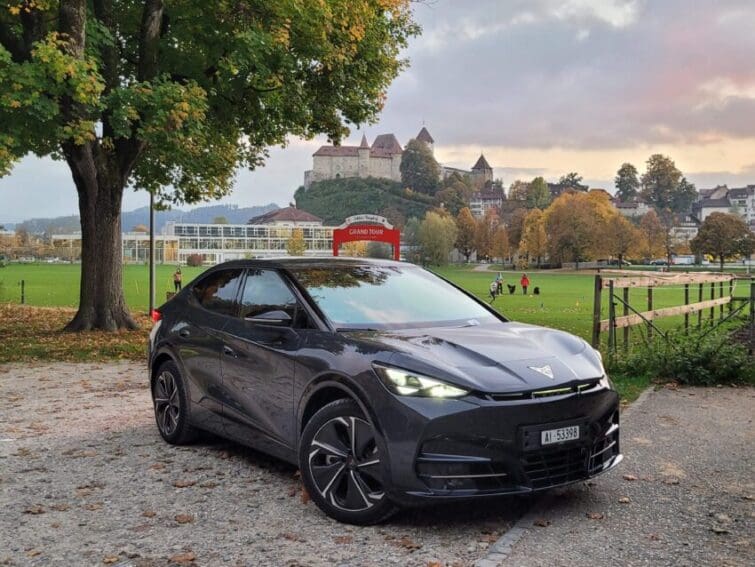
Pulling my Cupra Tavscan back into Zurich airport’s rental zone I had to take a moment to reflect that just four hours earlier I’d been looking down on the clouds from the top of the majestic Brienzer Rothorn. Just 24 hours prior to that, I’d been soaking up the autumnal beauty of the gentle Vallée de Joux. And less than two days before that, I’d been pretending I was James Bond, posing on the Furka Pass.
In fact, in four days I’d seen a bewildering number of sides to Switzerland as Cupra’s all-electric family SUV carried me along the route of the Grand Tour of Switzerland.
The Grand Tour of Switzerland (GToS) is a 1,643km (1,021-mile) road route designed to showcase the very best of this compact country, from its soaring mountains and breathtaking glaciers to its picture-perfect lakeside villages and vibrant cities.
2025 marks the tour’s 10th anniversary, which in itself would be a good reason to tackle it. But in recent years the people behind the GToS have embraced electrification and promoted the E-Grand Tour as a way to showcase both the country’s attractions and its EV-friendliness.


It’s marketed as “the world’s first road trip that can be travelled in electric vehicles”. I’m not sure that’s entirely true, but a few days at the wheel of the Cupra Tavascan proved it’s certainly an EV-friendly way to explore a vibrant country.
Precision planning
Time constraints meant I wasn’t able to cover the whole route, which loops around almost the entire country. Instead the smart people at Switzerland Tourism suggested an itinerary that covered around half of the tour and showed that there’s much more to Switzerland than cuckoo clocks and chocolate.
After flying into Zurich with Swiss Airlines I picked up my Tavascan and set off south along the banks of Lake Zurich before swinging west through picturesque Rapperswil (the town of roses) toward Altdorf, going the “wrong way” along the Tour route and skipping the no doubt stunning leg through Appenzell and down to St Moritz and Bellinzona.


As with any new EV there was a brief period checking the Cupra’s predicted range (468km/291 miles), watching how it changed with my driving style and wondering what the fitting of winter tyres and the prospect of some tough Alpine climbs would do to it. But, as with every EV, after an hour or two I’d settled comfortably into the Tavascan’s rhythm and gauged how trustworthy its computer was as well as scoping out some chargers, just in case.
The run from Zurich to lunch in lakeside Brunnen is a pretty one, dotted with neat villages overlooking the water. From Brunnen, a quick shortcut had me heading the “right way” again, rejoining the route between Bellinzona and Zermatt. Then the climbing began, following the river Reuss towards its source near the famous Furka Pass.


A mountain (or two) to climb
It’s roads like the Furka Pass that will defeat even the best EV trip computer. As I approached the start of the intimidating cross-mountain path, the car confidently predicted I had around 300km of range left. By the time I hit the top of the 30km climb, that had dropped to 173km. Forty kilometres later when I reached my hotel in Fiesch, it had climbed back to 230km. The joys of unpredictable terrain.
The Furka Pass had long been a dream drive for me and lived up to expectations. I posed for the obligatory shot at “James Bond Strass” – the famous Goldfinger location – as well as taking in the awe-inspiring 360-degree vista from the very top. On the way down, I stopped at the Instagram favourite Belvedere Hotel along with the ubiquitous Spanish travel vloggers and, randomly, an entire fashion shoot.


The Pass is a must-see on the Grand Tour but, be warned, it’s not for the fainthearted. The switchbacks and twists are easy to navigate even in a big beast like the Tavascan but the road varies from a full two lanes to barely more than single track, and on some sections all that stands between you and a drop of several hundred metres are widely spaced concrete bollards.
An overnight stop in nearby Fiesh, in the Aletsch Arena not only allowed a sampling of the German-influenced Alpine cuisine, but also presented the opportunity the next day to explore the Aletsch Glacier, Switzerland’s biggest glacier and one of countless “wow” moments along the route. Reaching the viewpoint nearly 3,000m above sea level requires two cable cars and a head for heights, but is totally worth it to see the 20km ice flow stretched out before you, and take in views that stretch from the Eiger to the Matterhorn and beyond.
It’s all downhill
The scenery of areas like the Aletsch Arena and Furka Pass is a key part of the GToS. It feels like around every corner there’s another picture-postcard village with its wooden chalets and fields full of cows, the echo of their bells clanking up the hillside clear over the silent progress of the Tavscan’s electric motors.
But beyond the jaw-dropping sights, there are the roads. Whether they’re twisting through the vertiginous glacial valleys or flowing through the softer wider lowlands, they’re interesting, impeccably maintained and dotted with the reassuring sight of EV chargers.
Moving from the Alpine region to the foothills, the cable cars are replaced by terraces of vines scaling the hillside as far as the eye can see. In Valais and Vaud, every spare scrap of land is covered in vines producing the delicious reds and whites for which they are famous.


The soft, rolling scenery of the Vallée de Joux, where I broke the journey on day two, has something of Highland Perthshire to it. The same glorious autumnal colours with trees draped in copper, ochre and yellow leaves, the wide grassy expanses and inviting lakes shielded by substantial mountains in the distance.
From the tranquility of the Lac de Joux, the next day took me to the historic lakeside city of Neuchatel, the picturesque Murten/Morat on the border of the French and German areas of the country and on to bustling Bern, where I could happily have whiled away hours marvelling at the architecture and sampling the varied food and drink. But time marches on. From the cosmopolitan capital, I quickly turned back onto more minor roads and began climbing again into the Entlebuch Unesco Biosphere – Switzerland’s first biosphere reserve and a haven for nature and sustainable tourism.
An overnight stop at the historic Flühli Hotel Kurhaus provided not only a dinner to die for but a gateway to the 400km² of mountains, meadows and more.
Variety is the spice of life
The genius of the Grand Tour is that it encompasses so much of the country and allows drivers to explore the many characters of Switzerland. Like Scotland’s North Coast 500 there’s something for everyone along the 1,600km – foodies, history buffs, culture vultures and active lifestyle types. And you can spend as much or as little time as you like travelling it.
Activities change with the seasons, visit in summer and you can strap your mountain bikes to the car and explore the rugged trails of Fieschertal and the Entlenbuch range. In winter, those same challenging mountains offer world-famous skiing.

For those with a love of history and culture, the route stops off in major hubs such as Geneva and Lausanne, as well as Bern and Zurich and innumerable other fascinating towns and villages. I even found time (pun intended) to discover the origins of the country’s most famous watchmakers among the “farmer horlogers” of the Vallée de Joux.
The GToS cleverly diverts you through apparently random towns and villages, inviting you to explore places you might have ignored. That’s good for visitors and the local businesses that benefit from the through-traffic. On the downside, it does sometimes mean picking your way through larger, less scenic urban sprawls.
The Grand Tour is broken down into eight clearly defined sections. That way you can choose to do one or two sections rather than tackle the entire tour in one go. Planning is simple too, thanks to a comprehensive website that details the highlights of each section, hotels and activities along the way. It even has a dedicated EV section.
On a charge
I worked out that I could have done the entire route in my four days, just. That would have been an intense few days packed with amazing roads and lots of driving but I would have missed out on so much. At every turn, I wished I’d had longer to explore different places – whether wandering the historic streets of Bern or trekking the mountains.
But the GToS is not just a sightseeing tour. For driving enthusiasts there are magnificent stretches of road ranging from the wide, sweeping curves and open sight lines of the Vaud’s valleys to the technical twists and turns of the mountainous Valais region. If you want to make it all about the driving, then you can.
And it’s all so easy in an EV. Range or charger anxiety is mostly nonsense, as EV owners know, but for anyone worried about tackling such distances, the route has you covered.


In planning the tour I’d opted for the 77kWh Tavascan from Europcar’s EV fleet to minimise the charging stops and give me more time doing activities. But range was never an issue. In fact, I reckon I could have completed the entire 850km trip with just one charge.
As it was, I charged three times. The last was a simple “might as well top up while I pee” on the approach to the airport. The first was done just in case the hotel ones were busy. That was at Relais du Saint-Bernard where 28 chargers from four different providers offered plenty of options for drivers in need of a top-up.
As it turns out, I needn’t have worried. The Hotel des Horlogers in Brunnen, where I enjoy a fabulous spa treatment and dinner, had a bank of eight Avia units ready to provide a full overnight refill (although at 75c/kWh, they weren’t cheap).
That hotel was one of more than 450 along the GToS route that offer on-site charging, meaning you can carry on your merry way without stressing over charging stops.

At no point did I feel nervous about charging but, like the UK, the main roads are better served than smaller, more rural routes. Even then, many of the towns and villages I passed through had at least a couple of 50kW units tucked away somewhere and plenty of visitor attractions have one or two low-powered “destination” chargers.
Helpfully, signage on major roads shows the next charging location and tells you how many bays it has, although they don’t indicate the operator or costs (just like most in the UK). Also like the UK, while some hubs were in huge service stations others were in less well-provisioned truck stop/parking areas. Positively, most seem to allow a simple contactless payment so there’s no need to worry about local operator subscriptions.
For planning, there is a Swiss map that shows the location of all of these charging stations . But it’s a very cluttered and old-fashioned affair with an awkward interface and little scope to filter by criteria such as speed or operator. Oddly, Zapmap doesn’t cover Switzerland, so you’re best off relying on Google, ABetterRoutePlanner or your EV’s on-board mapping to help you spot devices en route.
Doing that will let you relax and enjoy the experience of exploring a very varied and fascinating country. You can take it at your own pace and bash round hundreds of miles in a short space of time revelling in the roads and scenery. Or you can take your time, make more stops, explore what the towns and villages along the route have to offer.

Whichever option you choose, doing it in an EV is as easy as in any other car, perhaps easier as you avoid Switzerland’s ruinously expensive petrol prices.
Having ticked off 834km of the Grand Tour, I’m already planning my return to cover the other 809km.
- Matt flew SWISS from Edinburgh to Zurich (SWISS.com) and explored the E-Grand Tour of Switzerland in an EV from Europcar (europcar.ch). For more information on the E-Grand Tour, visit the Switzerland Tourism website: grandtourofswitzerland.com