
An electrifying journey into the future of motoring with ZF
EVs have come on leaps and bounds since they entered the mainstream in 2010, yet what’s next? We dust off our white coats, and head to ZF’s UK headquarters in Solihull to get an understanding of Software Defined Vehicle tech, and what lies ahead for all-electric vehicles
When the Nissan Leaf arrived in 2010 with its odd looks, modest 109-mile range and 24kWh battery, few would have imagined the successes that electric vehicles would go on to have a decade and a half later. In 2023, the Tesla Model Y achieved the unthinkable by overtaking the Toyota Corolla as the world’s best-selling car.


In addition to matching – and sometimes even surpassing – the mileage achieved by an internal combustion (ICE) vehicle, EVs are now seen as performance vehicles in their own right. There are many reasons why the Hyundai Ioniq 5 N garnered accolades such as World Performance Car of the Year 2024.
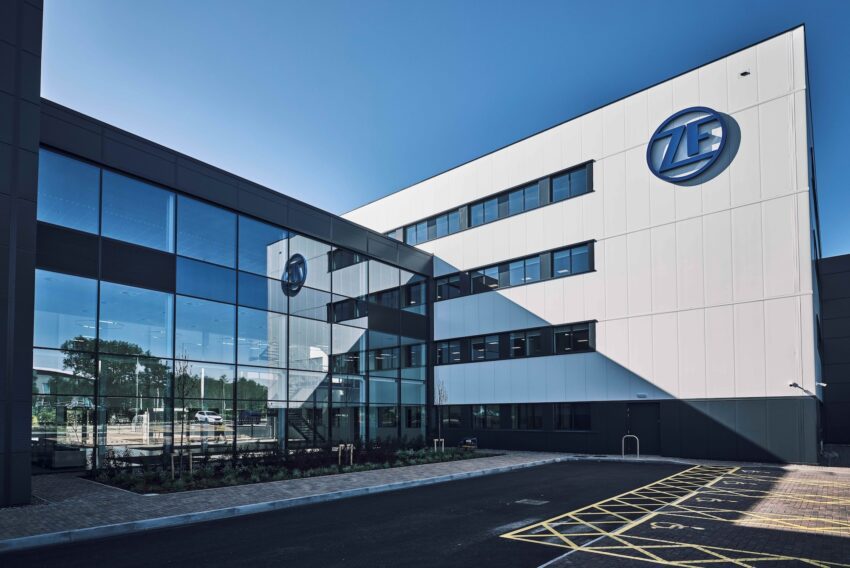
Yet where is this trend of EVs at the forefront of the automotive world headed? EV Powered visited ZF’s UK headquarters in Solihull to find out.
Defining the future with SDVs
As a reminder, ZF – or ‘Zahnradfabrik Friedrichshafen’ – is a German firm best known for its automatic transmissions. In fact, it’s been building them since 1920. Yet there’s heaps more that the company is doing, especially in relation to EV technology. With a keen eye on what’s to come during the years ahead, ZF believes that ‘Software Defined Vehicles’ or SDV is where the future lies.
Put simply, an SDV has the bulk of its functions controlled by software, meaning most new cars fall under the SDV umbrella. In the context of software defined EVs, their hardware including steering, brakes, and damping is managed by smart actuators paired with smart sensors rather than old-fashioned mechanical linkages. In automotive terms, this is the car world’s answer to aviation’s fly-by-wire system.

Ultimately, ZF feels this largely hardware-free approach will strike a balance between performance, efficiency and reliability. Even now, SDVs benefit from cloud-based over the air (OTA) updates to make improvements to battery range, handling, and infotainment.
While many newer EVs benefit from the SDV approach, two in particular spring to mind – the Nio ET9, and the Farizon SV van. The ET9 is China’s riposte to the Mercedes S-Class, and holds the title of the country’s first mass-produced car to be fitted with a steer-by-wire (SBW) system.
Nio cites higher steering response speeds as its reasons for adopting SBW. Moreover, SDVs can return real-time data to the manufacturer regarding where improvements to their systems can be made.

At the other end of the automotive spectrum, the Farizon SV is an all-electric cargo van that uses by-wire controls for steering, throttle and braking. Its combination of sensors, servos and control units allow all the main inputs to be managed without cumbersome physical connections. Not only is this good for packaging but it also helps save weight and improve efficiency – something we will explore further later on.
First though, performance…
Formula Student and performance mapping
ZF is a keen supporter of Formula Student UK, a race car engineering competition organised by the Institution of Mechanical Engineers, which is held each year at Silverstone.
ZF supports UK universities by inviting the brightest and best teams of mechanical engineering students competing in Formula Student’s driverless, all-electric category to Solihull. There they can use ZF’s cutting-edge facilities as a sandbox to shakedown their self-designed vehicles, and get ready for the Silverstone event.


A ZF engineer involved with the Formula Student UK programme explained to EV Powered that a large part of the preparation involved with the Silverstone event is how students take the performance and behavioural data from the ECU of the previous year’s challenger, and apply it to this year’s car to make it more competitive.
In simple terms, the data code is extracted to a hard drive, where it is stored. The code is then altered on a computer to adapt to any changes in the circuit via power delivery, steering, and suspension. To apply the changes, the student then plugs the hard drive into the car’s ECU and it reads the code accordingly. Once again, the data is extracted, altered, and re-applied in pursuit of the perfect setup.

While this isn’t happening in the world of road-going SDVs just yet, ZF fully believes it’s quite feasible in the future. To put things into perspective, an automotive engineer could map the driving characteristics of a Toyota GR Yaris onto a Skywell BE11. Not that you’d want to.
The chase for efficiency
The performance aspect of things, however, is just one small part of the SDV. As well as reporting live data as a way of allowing manufacturers to make constant improvements to their vehicles, ZF is aiming to make EVs quieter and more refined by taking an adaptive approach towards efficiency.
In this age of downscaling, it doesn’t mean cutting costs, either.
“Even the slightest micro oscillation from a part can have a knock-on effect to the rest of the vehicle and create a vibration. In turn, this affects overall refinement and efficiency,” explains Dr. David Moule, a ZF technical specialist in electric drivetrains. “This means sometimes you have to add mass and strengthen a component to eliminate the oscillation. However, you’ve added weight, which is something you want to keep to an absolute minimum on an EV.

“By eliminating physical components such as steering columns and braking systems, you remove several heavy components and replace them with a digital system, which reduces weight, and can be improved over the air as it tracks real-time data. When you take out weight, you improve range, vehicle efficiency, refinement, and so on. Then you find yourself in a virtuous circle as everything is working together in a more efficient way than before.”
In its pursuit to improve SDV efficiency, ZF isn’t just experimenting with masses, wireless systems, and removing components. Within the electric motors it produces, it has experimented with different types of steel for the motor’s magnets, with alternate grades providing varying levels of energy loss.
ZF has even gone so deep as to adopt different steel milling techniques for the same component. For example, the shaft on two electric motors may appear the same to the naked eye. Under a microscope, however, their ridging appears different in the name of efficiency. It’s apparent that ZF operates beyond what’s visible.
What’s next for EVs?
As the day winds down, it seems appropriate to loop back to the ZF philosophy of making things as efficient as possible. SDVs built prior to 2022 are controlled by a series of decentralised ECUs positioned around the floorpan.
Those manufactured from this year to 2030 will be managed by three main modules positioned at the front, middle, and rear of the car with fewer ECUs. Fast-forward to 2030 and the German manufacturer believes that SDVs will have just three areas of centralised electronic architecture – rear zone, central zone, and front zone.

Undoubtedly, EVs will still have their naysayers. The hackneyed ‘milkfloat’ and ‘mobile phone’ tropes will be wheeled out by the usual suspects. Yet based on the mere glimpse we were offered by the tour around the ZF Solihull site and Dr. Moule’s brain, all of us who have embraced electrified motoring are standing on the edge of something exciting in terms of tech and seemingly infinite possibility.