

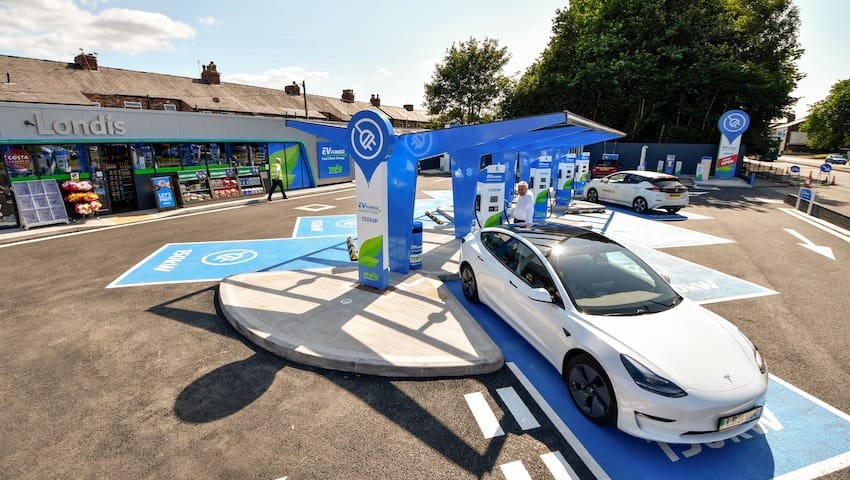
Octopus has struck deals worth up to 30% off public charging for business fleets, taking aim at one of the biggest costs facing firms that swap petrol and diesel for electric cars and vans.
The new FleetBoost scheme already covers MFG EV Power, Ionity and Be.EV chargers, and the UK’s largest energy supplier says it hopes to sign up more networks over the coming months.
FleetBoost is sold as a monthly subscription charged per driver through Octopus Fleet, the business platform built with Rightcharge that Octopus launched to help companies switch their fleets to EVs earlier this year.
Through the platform, drivers can locate and pay for public chargers, home charging reimbursement claims are handled automatically, and fleet managers get a single view of what the business is spending.
According to Octopus, the three founding networks between them put 99% of the UK within 14 miles of a FleetBoost site. Discounted chargers are flagged in the app so drivers can find them quickly.
Why fleets get the better deal
The thinking behind the discount is straightforward. An Octopus spokesperson told Autocar that fleets provide a “reliable” flow of vehicles, keeping chargers busy, and that this gave the company the bargaining power to negotiate lower rates.
Octopus has yet to publish the monthly fee in its FleetBoost announcement, but reckons membership will pay for itself after as few as two charging sessions.
That should catch the eye of finance directors, because public charging has become a costly problem for fleets. A recent Rightcharge report claimed public charging made up 27% of fleets’ total charging sessions in 2025, yet swallowed 57% of what they spent on electricity.
The spread between the cheapest and dearest electricity is huge. The most expensive networks can charge 93p per kWh, while drivers plugging in at home on a tariff with cheap overnight rates can pay less than 7p.
ChargeUK, the trade body for the country’s charge point operators, puts the gap down to high energy prices and standing charges, along with the 20% VAT applied to public charging compared with 5% on home energy.
That tax split has long riled the industry, and a tax tribunal ruled in March that public charging should, in some circumstances, attract the lower 5% rate.
The effect on running costs is stark. For a Tesla Model Y, the cost per mile can swing between 1.5p and 21p depending on where it is charged.
Set that against the latest HMRC advisory fuel rates, which suggest 16p per mile for an equivalent diesel car or 17p for petrol, and a Model Y fed only on the priciest public chargers could cost more to run than its combustion-engined equivalent.
Matt Davies, founder of Octopus Fleet, said: “We know that switching a fleet to electric is about much more than putting an EV on the road. Businesses need charging to be affordable, reliable and easy for drivers to use and we’re tackling this all in one go.
“By bringing together some of the UK’s biggest charging brands, we can help accelerate the transition to commercial EVs and slash the cost of public charging for businesses.”


