


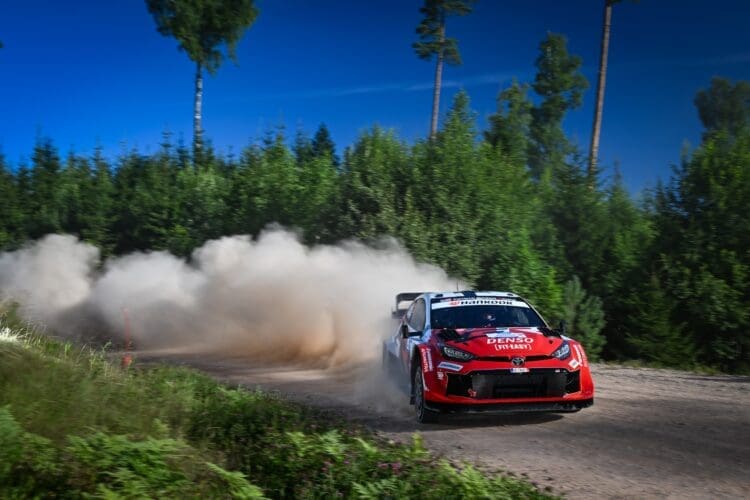


Double-World Rally Champion, Marcus Grönholm, believes EVs in the WRC “could work” as long as the FIA writes the rulebook with clarity and a long-term vision.
On August 27, the FIA announced that the WRC will allow an open powertrain choice from the 2029 season onwards.
This means that while teams will have to run the turbocharged internal combustion Rally2 engine for 2027 and 2028, they’ll be able to run whatever powertrain they like from the following year.
The FIA decided on powertrain flexibility to attract more competitors to the WRC, and reflect the electric, hybrid, and pure internal combustion-engined (ICE) powertrain strategies adopted by car manufacturers globally.
Speaking to DirtFish, the FIA’s technical director, Xavier Mestelan Pinon, said that the concept of an all-electric WRC car is “not completely crazy”, but does come with the challenge of introducing charging infrastructure.
“Full EV for a WRC application, it’s not completely crazy, except the fact that you need to charge between two stages,” he explained. “But full EV at the current power, so we’re speaking about 300 horsepower more or less, for stages around 30 or 35 kilometres, it’s not an issue.
“With the battery around 40 kilowatts, you can do easily a stage with 35 kilometres plus 100 kilometres for the road section. So it’s not a challenge.”
Grönholm, whose son Niclas was a multiple race winner and 2025 vice-champion during the FIA World Rallycross’s EV era, was equally as receptive to electric-only powertrains, but stressed that the regulations would have to be clearly defined by the FIA to bring in any potential newcomers and retain them.

“The most important thing is that the regulations have to be clear and easy to understand, so if electrification can bring in 10 new teams, then that’s no bad thing,” Grönholm told EV Powered. “If the regulations are good, the engineers are good, and they are allowed to do whatever, why can’t electric WRC work?”
Citing Niclas’s involvement in electric World RX, the winner of 30 WRC events was unconcerned about having electric and internal combustion powertrains run alongside each other on the WRC stages.
As his barometer, the Finn used World RX’s ‘Battle of Technologies’ format, which pitted EVs and ICEs against each other on the same circuit at the same time during the 2024 and 2025 seasons. At the end of both, the EV came out on top.
“As a concept, the Battle of Technologies was pretty good,” Grönholm recounted. “The racing wasn’t bad, but again, the regulations were not so well enforced. Last year in World RX, we had a team and its driver switch from ICE to EV. I didn’t think it was right that they were able to do that, and I still don’t.”
“If we are to have EVs in WRC, we can’t have a team change powertrains mid-season because they don’t like losing. At least that’s what I think.”
Yet again in August this year, the WRC openly admitted “we want a Chinese manufacturer,” with Chinese automotive giant Geely and its Lynk & Co brand having already shown an interest in competing.
Given both carmakers focus exclusively on hybrids and pure EVs, Grönholm questioned whether manufacturer influence had been part of the FIA’s decision to open up the WRC’s powertrain regs.

“I honestly don’t know, but maybe there’s been some pressure on the FIA?” he contemplated. “But at the end of the day, I just hope that lessons have been learned from what happened in World RX and our sport can get back to the top where it belongs. If that involves having EVs onboard, then I am okay with that.”
Alongside the Rally2 engine, competitors in the WRC from 2027 onwards will be required to build their car around a spaceframe chassis. In theory, this means that they are able to run any body style they want as long as the engine and chassis are rule-compliant.
Looking ahead to the 2029 powertrain changes, Grönholm, now 58, joked about the infamous Peugeot 307CC WRC – a car with which he had a notoriously rocky relationship – making a comeback after more than 20 years.
“Imagine what could happen when the engineers are allowed to run wild – the 307 could even return as an electric [car]!” he laughed. “I hope they don’t, but they might even call me back to drive – after all, EVs only need one gear, not three!”


