New cooling tech could slash charging times to 10 minutes
A new breakthrough in battery cooling could help cut a typical ultra-rapid charge time by up to 20 minutes, according to the scientists behind the technology.
The world-first Dectrvalve system helps EV batteries remain at their optimum operating temperature, aiding faster charging as well as boosting efficiency and bringing potential safety benefits.
High temperatures and fluctuating temperatures across a battery are among the reasons while EVs can’t deliver their peak DC charging for long. Management systems reduce power going into the battery to protect it from damage.
However, Hydrohertz, the company behind Dectravalve, says its technology addresses both of these issues, allowing for higher power delivery for longer and ICE-comparable refuelling times.
It says the system, which works with any EV battery, will cut the 10-80% charging time of a 100kWh battery from 30 minutes to just 10 minutes on a 350kW charger.
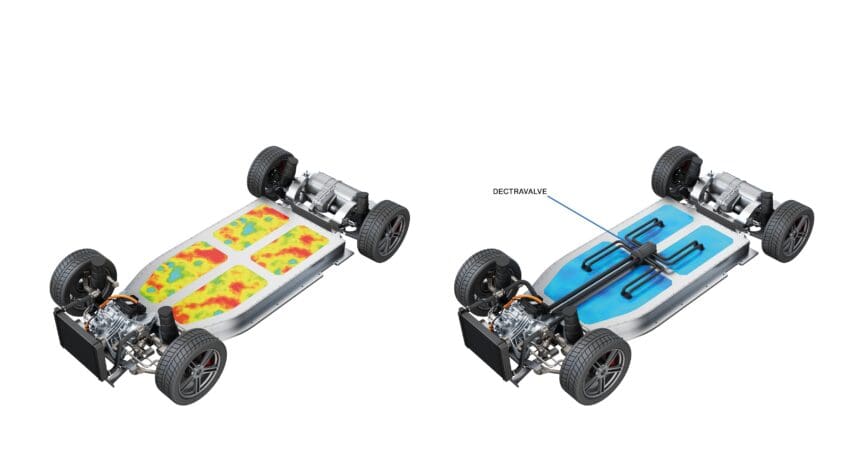
The multi-zone valve system allows precise heating or cooling of a battery on a module-by-module basis, making it easier to ensure a steady, consistent temperature across the entire pack.
In an ultra-fast charging test with independent battery experts Warwick Manufacturing Group, a 100kWh Lithium Iron Phosphate EV battery equipped with Dectravalve kept its hottest cell at under 44.5°C, maintaining a temperature difference of only 2.6°C across the whole pack, and keeping the battery within the optimum high-power window for the entire charge time.
That is compared with typical current ultra-rapid charging, where peak cell temperatures regularly rise to as much as 56°C and the temperature difference across the pack can exceed 12°C.

Once cells get beyond 50°C, charging power has to be throttled back to avoid internal damage to the cells, known as lithium plating. and long-term damage to the pack, meaning fast charging tapers off much earlier than advertised, significantly increasing the overall charge time.
As well as improving charging speeds, Hydrohertz says the system helps to extend range by up to 10% by ensure a battery always remains at its optimum operating temperature.
Such precise temperature management is also good for battery longevity – a key concern, especially around used EVs. And its creators say it’s also good for safety.
By capping cell temperatures and managing them on a module-by-module basis, the system can better prevent overheating, reducing the risk of lithium plating and of thermal runaway.
Paul Arkesden, CEO of Hydrohertz, said: “The automotive industry has been waiting for battery technology to catch up with consumer expectations, but progress has been slow and expensive. A new chemistry can take a decade to develop and require billions in investment. What we’ve done is take a different approach – we’ve dramatically improved how existing batteries perform by perfecting the thermal management of them.
“This is a cost-effective solution that delivers game-changing results: consistent 10-minute charging, longer range, extended battery life, and enhanced safety. ”