Citroen E-C5 Aircross review: The super-squishy SUV sweet spot
Citroen’s flagship family SUV brings comfort, value and an astonishing range to a super-competitive segment
The Citroen E-C5 Aircross might be an SUV, but Citroen says it is the spiritual successor to innovative cars like the Xsara Picasso and C4 Spacetourer. Like everyone else, Citroen decided about 10 years ago that proper MPVs like the Spacetourer were history and big SUVs the future of family transport— boo!
Personal taste aside, the C-SUV segment accounts for a quarter of new car sales in the UK, so it was a smart move. But since the first C5 Aircross came along in 2017, EVs have taken off, leaving the ICE and hybrid model trailing.
Now, though, Citroen is fighting back with this electrified rival to the Skoda Enyaq, VW ID.4 and Kia EV5, hoping to wow customers with exceptional value and the longest range in its class.
Citroen E-C5 Aircross design, interior and infotainment
The original petrol-powered C5 Aircross was a bit of a soft, blobby thing. That bubbly look was part of Citroen’s aesthetic back in the mid-2010s but since then the brand has reached for the scalpel and adopted a sharper edge.
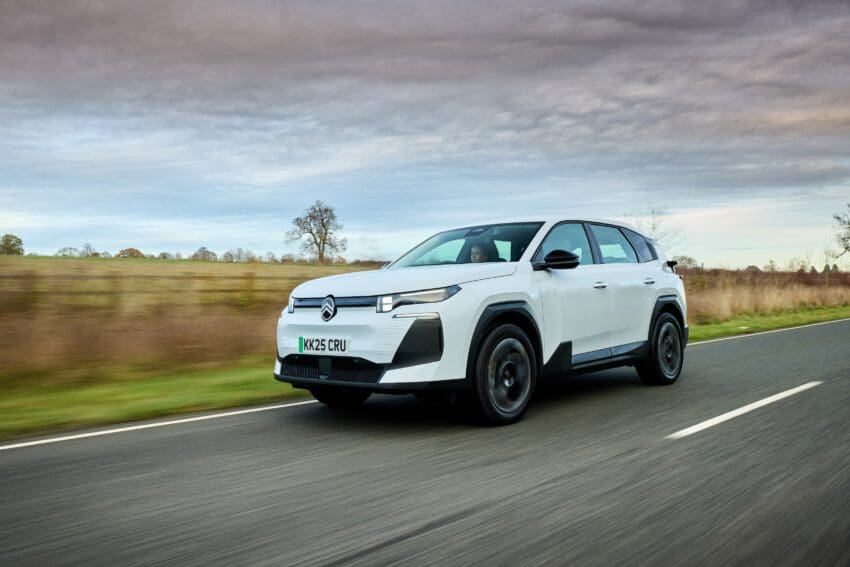
So this all-new C5 gets a more defined and refined design with crisper lines and an unapologetically upright SUV look.

Head-on that manifests in a tall, bluff front end with neat cuboid headlights and slim running lamps, plus a sharp-edged smooth bumper. A tapered waistline not only gives some definition to the car’s profile but, apparently, helps add 15 miles of range due to its aerodynamic contribution. Perhaps unusually, the E-C5 Aircross is most striking and individual from the rear, where three-section tail lights jut out like mini wings and wrap around onto the rear three-quarter panels.
The overall effect is perhaps not as quirky as the old car but it ties in well with the rest of the Citroen range and looks clearly like a bigger brother to the compact E-C3 Aircross.
Inside there’s less family resemblance and the E-C5 Aircross is a far more upmarket affair. Material quality is a real step up not just from the old car but also from the rest of the Citroen range. Citroen says there’s a particular focus on quality in the new E-C5 and it certainly seems apparent in the solid feel of all the switchgear and interesting material choices. There’s still a bit too much piano black plastic and a few common Stellantis switches but in general it’s in keeping with the E-C5’s flagship status.
Specification makes a big difference to the interior ambience, however. The entry-level You! trim has decent materials but feels a little dark and drab. The Max trim with its cream faux-leather seats and wonderful ‘sofa fabric’ dashboard finish is lighter, smarter and more welcoming, especially if you spec the massive panoramic roof.
There’s more head and legroom than in the previous Aircross but behind the Advance Comfort front seats (they do what it says on the tin) Citroen has ditched the three individual rear seats of the first-gen car. It says research shows owners of first-gen cars rarely used the middle seat, so it decided to give those on the outer pews a bit more space. For most people this probably makes sense, but as someone with three kids, it lessens the practicality and robs the E-C5 Aircross of one of its unique benefits over rivals. Oddly, though, the seat back still splits 40/20/40.

Citroen boasts that the E-C5 has class-leading boot space at 651 litres. That’s a great, usable space with a flat load lip and huge opening. But all that room comes at the expense of rear legroom. There’s still enough for a couple of average-sized adults front and rear, but rivals such as the MGS6 offer far more space behind taller front seat occupants.
At the centre of the new E-C5 sits the biggest portrait touchscreen fitted to any Stellantis model. This 13-inch unit flows from the lip of the dashboard down into the centre console, sitting above a wireless phone charger and a bank of tactile physical buttons for climate functions. The screen is sharp and responsive and Citroen has taken care to make it easy to use. There are big simple menu icons and no long lists of options. Every control is big and easy to hit on the move, including the temperature controls permanently anchored to the bottom of the screen. There’s also a handy shortcut key that can be programmed to open the ADAS settings at one touch. As standard, the E-C5 Aircross supports wireless Android and Apple mirroring as well as coming with Citroen’s own EV-specific navigation system. High-spec models add a head-up display to supplement the 10-inch digital instrument panel.
Citroen E-C5 Aircross battery, motor and performance
There are two powertrain options for the Citroen E-C5 each with a different motor and battery.
The “comfort” range model kicks things off with a 207bhp motor driving the front wheels and a 73kWh battery delivering a WLTP-rated 322 miles of range. That’s a decent showing for the class and already outperforms a lot of Chinese alternatives.
Above that there’s the long-range version which offers a massive 421 miles from its 97kWh battery. That instantly catapults the E-C5 Aircross not only to the top of its class but onto the list of the longest-range EVs on sale. It also gets a modest power boost to 227bhp.

My first impressions are limited to the less-powerful model but I suspect the extra oomph of the long range version might be a smart choice, especially if you regularly carry a full car load.
The comfort range car’s 207bhp is definitely adequate for the car and will get it from 0-62mph in an acceptable 8.9 seconds. But it lacks the grunt of something like the Enyaq or Ford Explorer.
That’s amplified by a slightly dulled throttle response and equally soft steering. There’s a squishiness to both inputs that’s at odds with many “sporty” rivals. It’s still composed and predictable, just not dynamic.
In fact, the whole experience is a little like driving a marshmallow — not in a bad way, just in a very Citroen way. Everything is calibrated for gentle progress and soothing movement — from the slightly damped throttle and steering to the exceptional ride comfort.
Citroen’s “thing” is to be the class leader for comfort and it delivers here courtesy of the Advance Comfort suspension with its clever hydraulic bump stops. This really does deliver unrivalled ride comfort. You still notice lumps and bumps but impacts that would send judders through the cabin of any rival are soaked up with remarkable composure. If comfort is your priority, look no further.
Citroen offers three levels of braking regeneration which, frankly, feel like they need work. There’s no full one-pedal mode, nor can you fully deactivate it to coast. While it works well enough at lower speeds, on country roads it felt a little underpowered and I found myself using the brake pedal more than I expected.

Over a couple of drives in different variants, I saw an average consumption of 3.5m/kWh. That’s not groundbreaking but nor is it bad for a chilly November day, and equates to around 255 real-world miles between charges.
Both batteries charge at up to 160kW but the larger battery manages the 20-80% refill in 27 minutes compared with 30 for the smaller unit, thanks to a better charging curve.
Citroen E-C5 Aircross price and specification
Citroen now has seven EVs priced from under £33,000. The fact cars like the E-C3 and E-C4 are in that list shouldn’t be a surprise. The fact the E-C5 Aircross is on it is perhaps more shocking.
Thanks to the application of the Electric Car Grant, the fully electric C5 Aircross starts at £32,565 and tops out at £38,215.
Of particular note is that the long-range version — whose batteries are built in France — gets the full £3,750 discount while “comfort range” models with Chinese batteries only get a £1,500 grant. That means you can have an extra 100 miles of range for less than £500 more.
Even without the discount, the E-C5 Aircross would start at less than £34,500, undercutting pretty much every rival, including most of the options from newcomer Chinese brands — the masters of competitive pricing.
For reference, without the grant, the Skoda Enyaq starts at £39,010 for the 270-mile version, while the 360-mile Renault Scenic starts at £36,995. Exceptionally, the Leapmotor C10 starts at £32,750 after the brand’s own in-house grant. Citroen fights back with an eight-year warranty to the C10’s four, and 60 more miles in its shorter-range model.

Citroen’s basic equipment level isn’t as generous as most Chinese alternatives, who tend to come in one fully-loaded trim. But climb to the top-of-the-range Max and you’ll get all the expected bells and whistles, and still be paying just a whisker over £38,000 for the 420-mile range version.
You’ll probably want the Max spec as it adds heated seats, a heated steering wheel, heat pump, powered tailgate and Matrix LED adaptive headlights – a Citroen first.
Below that, You! trim starts the range off with 18-inch alloys, keyless start, dual-zone climate control, adaptive cruise control and rear parking sensors. Plus trim adds 19-inch wheels, tinted rear glass, part-faux-leather upholstery, keyless entry, and reclining rear seats along with a reversing camera and front sensors.
Verdict
With the current ECG the E-C5 Aircross represents incredible value, especially in long-range guise. Nothing else can offer close to its 421-mile range for similar money.
But there’s more than just a low price to recommend. Rear legroom isn’t the greatest and the driving experience not the most dynamic but the E-C5 Aircross is an impressive all-rounder with an impeccable ride, controlled road manners and a neatly designed, comfortable interior.

Citroen E-C5 Aircross Max
- Price: £37,845 (£39,490 as tested)
- Powertrain: Single-motor, front-wheel-drive
- Battery: 73kWh
- Power: 207bhp
- Torque: 253lb ft
- Top speed: 106mph
- 0-62mph: 8.9 seconds
- Range: 320 miles
- Consumption: TBC
- Charging: up to 160kW