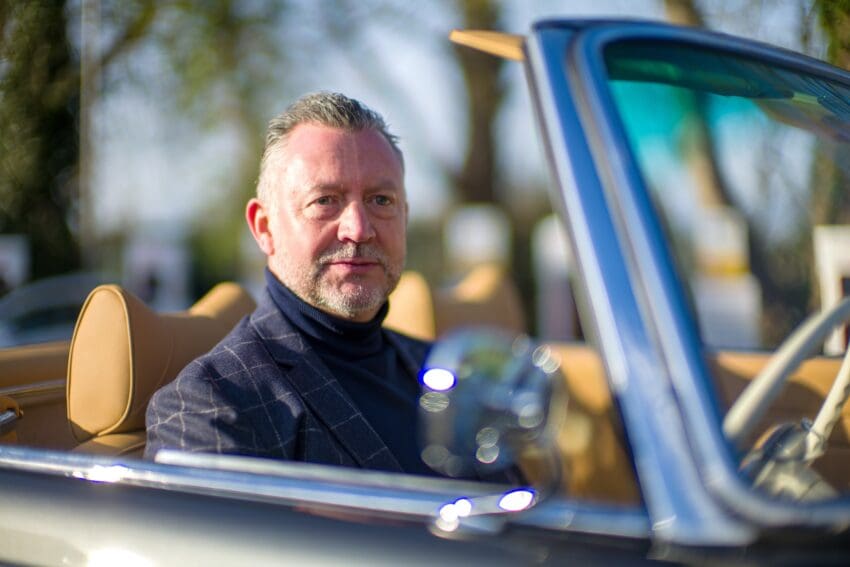
Justin Lunny talks Everrati, luxury, and how electrified classic cars silence the critics
Defining a luxury car is no easy task.
If, for example, you are of a Trumpian ilk, then a gold-plated Cadillac Escalade will tick your boxes. Should you grease your palms with tax-free silver in, say, Dubai, then possibly a Mercedes with a light-up front end that puts Blackpool Illuminations to shame would be more your thing.
Thankfully, Justin Lunny has a different outlook. He interprets a luxury car as something that people want to “mark them as something different to the likes of the Rolls-Royce Spectre or the Cadillac Celeste; a luxury car is about being quiet and high performance without being super quick, and a place where you can relax.”
Why the electrified classic car market is here to stay
Why this matters is because Lunny is the founder and CEO of Everrati, a UK-based firm specialising in restomodding – and electrifying – some of the automotive world’s most sacred cows.
If you were wondering, Everrati’s current range comprises four Porsche 911s (993, 964, and original 911 for the Stuttgart-minded), a Mercedes W113 SL Pagoda, the Mk2 Ford GT40, and two classic Land Rovers; the Series IIA and the Everrati-only Shoretender.
At this point, certain sections of the car community will get all pitchforky about Everrati “ripping out the souls” of these much sought-after classics. Yet why Oxfordshire-based Everrati chooses to reimagine these cars as small-batch, tailor-made EVs is simple: as Lunny tells EV Powered: “There’s a demand for it.”

In fact, Lunny reveals that at the end of 2025, Everrati’s order books were up almost 150% on the previous year.
“I think the appeal of our electrified classics is that we give people the opportunity to drive what was their halo car when they were younger, and the electric drivetrain removes some of the hassles that may or may not come with a combustion-engined car of a certain age,” he explains.
“With our cars, it’s key to remember that the powertrain isn’t really the thing here – it’s all about luxury, and it’s about being a quiet place where you can relax – EVs are very good for this.”
Early adopters
While Lunny cites a “multi-million pound, high-end luxury car market” in 2026, he’s keen to stress that Everrati’s vehicles are aimed at a certain type of buyer.

“Generally speaking, 80% of our buyers are in the US right now, and they love tech,” the 54-year-old says. I think it’s fair to say they’re relatively early adopters,” he says. “We have clients who will spend $450,000 US Dollars on one of our cars, and use it every single day over whatever other cars they have in their collection.
“For us, that’s a brilliant proof point and shows just how much people love what we are doing.”
It would be easy to think that the Everrati magic lies solely in its largely unaltered designs and the effortlessly smooth driving experience that comes courtesy of an electric motor.
Justin Lunny on what makes an Everrati and Everrati
Alright, sure – the latter is part of this, but as Lunny is keen to bring to the fore, the skill of the engineering team at Everrati’s Bicester HQ is in retaining the character of the original donor car.
An Everrati machine, then, is not just a classic car with straight swap EV underpinnings borrowed from a Tesla Model S. Instead, its “millimetre perfect” powertrains are built with componentry sourced from “a motor provider who supplies Formula E, and Aston Martin with the hybrid motors for its Valkyrie”.

The first part of the Everrati recipe is its in-house developed software. As we discovered last year during our site visit to ZF’s UK headquarters, tuning software permits engineers to map the driving and performance characteristics of one car onto another. After all, “you wouldn’t just throw a V12 into whatever you’re driving at the time and expect it to work”.

The second is its approach to vehicle modelling. “We treat each of our cars as a new vehicle programme, almost in the same way that an OEM would,” Lunny explains. “We take everything back to the chassis, where everything is 3D scanned and then CAD engineered not only in terms of where we can fit things, but in terms of weight distribution.
“We’ll never make a vehicle that’s overweight, and thousands of hours go into building each of our cars.” To be precise, that’s five billion CAD points scanned, and 6,000 man-hours.
“We take lower rung cars, then give them a second life by turning them into something really rather beautiful”
Asking Lunny to pick a favourite Everrati car would be like asking a parent to choose their favourite child. It’s a non-question. He does, though, harbour a soft spot for its Porsche 964 RSR and the Mercedes Pagoda.
While it may sound sacrilegious to some, dropping the RSR’s 3.8-litre, air-cooled flat six for a rear-mounted, 500bhp electric motor and a 62kWh battery makes sense from a vehicle dynamics perspective, especially when you’re driving this second-gen 911 as it should be driven.

Lunny is also keen to emphasise that the donor cars are far from concours-level. “With our 964s, they’re generally pretty tired and unloved vehicles,” he stresses. “We also use narrow-body cars as the source for our 911s. The Pagoda is a little different, as we start with the 230 SL instead of the more sought-after 280. Ultimately, we take lower-rung cars, then give them a second life by turning them into something really rather beautiful.
“With the Porsche, we’ve focused on balance and weight distribution because that’s what this car is about. Almost every panel is carbon fibre, meaning we’ve removed 25kg of weight. It’s also 60% more powerful than the original, so that makes for quite a fun equation.

“We’ve upgraded the brakes, the suspension, and various other items, and while you won’t hear the flat six, it has so much character and soul thanks to the work we’ve put in and how it drives. In fact, Jonny Lieberman from MotorTrend said it’s the best 964 he’s ever touched. That’s praise indeed for us, because at the end of the day, we’re car people.”

As for the Pagoda, Lunny creates an almost dreamlike visual guaranteed to tickle the fancy of any self-respecting car enthusiast, EV fan or not.

“Honestly, our Pagoda is a work of art. It’s actually recreated by the same team that restores vehicles for the Mercedes-Benz museum in Stuttgart. It’s beautifully finished and beautifully refined. Driving it on the right roads, well… it’s quite an enjoyable exercise.”
“We’re not out to ruin classic cars- we’re here to preserve them to ensure they can be enjoyed for the future”
Following a successful 2025, Lunny reveals that Everrati is working on a new restomod scheduled for release later this year. But he stops short of saying exactly what it is. He also urges naysayers to view electrified classics as future-proofed, instead of ruined.
“We’re looking at other front-engined, rear-wheel drive vehicles within the kind of Mercedes stable,” he admits. “If you think about it, that layout is pretty much perfect. There’s a reason Rolls-Royce, BMW, Bentley, and as I said, Mercedes, used this configuration from the 1960s up until as recently as the ’90s.

“When I founded Everrati, people questioned my sanity, but we’ve shown that people want these cars – we wouldn’t still be here otherwise. Sometimes, in their original form, classic cars are not that great to drive and become a case of never meet your heroes.
“We want to avoid that, and we’re not out to ruin them – we’re here to preserve them to ensure they can be enjoyed for the future.”