Used Porsche Taycan review and buying guide
Ignore the few remaining naysayers: a used first-gen Taycan is still very much a proper Porsche.
Contrary to popular belief, the Taycan isn’t Porsche’s first all-electric car. In fact, that accolade goes to the quad-motor 1890 Lohner-Porsche Electromobile, weighing in at over four tonnes and packing an 80-volt lead-acid battery.
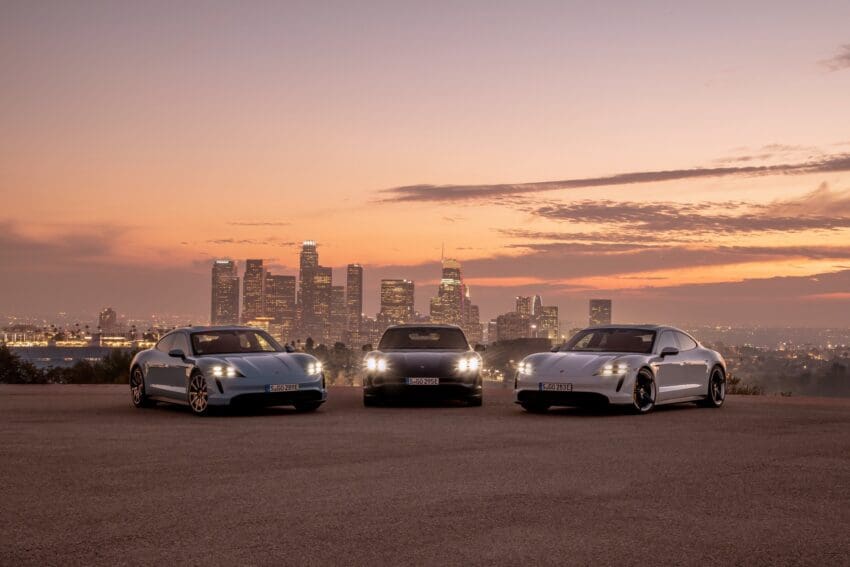
Fast-forward to 2019, and the Mk1 Porsche Taycan quickly became the first mass-market Porsche EV. It also proved the ‘you can’t have an electric Porsche’ types wrong. Thanks to a low centre of gravity and a clever adaptive suspension system, Stuttgart’s fabled vehicle dynamics, and up to 778bhp on tap, the Taycan was proof that Porsche and EV fans alike could have their cake and eat it.

The first-gen Porsche Taycan was in production until as recently as November 2024, when it underwent a facelift. Nonetheless, where other early luxury EVs have fallen by the wayside since their debut at the beginning of the decade, Taycans remain popular among used EV buyers, who love them for their signature Porsche drive and world-class engineering.
What’s more, opt for a longer-range Performance Plus car with the 93kWh battery, and you’ll have up to 282 miles of range and ultra-fast charging speeds of up to 270kW.
Ultimately, with some patience and the right information to hand, it’s possible to buy one of these landmark Porsches for around £43,000 from an official dealer.
Porsche Taycan model history
The Porsche Taycan arrived in September 2019 in either Turbo or Turbo S guise. Both were all-wheel-drive and both produced 616bhp in normal operation. However, with the temporary power boost afforded by a steering wheel-mounted button, the Turbo could produce 670bhp while the Turbo S churned out 750bhp. Within a couple of months, a twin-motor Taycan 4S debuted as the ‘entry-level’ model beneath the two Turbo cars. Depending on which battery size you opted for (79kWh or 93kWh) you got 430bhp or 483bhp, boosted to 523bhp or 562bhp.
That battery size also affected the entry-level rear-drive Taycan and all-wheel-drive Taycan 4, which both arrive in 2021. In “normal” mode, the small battery Taycan produced 324bhp, boosted to 402bhp. The big battery turned things up to 376bhp/469bhp.
That same year, the Cross Turismo shooting brake, its lower-riding, sportier nephew, the Taycan Sport Turismo, and the 509bhp/590bhp GTS would join the fold.
Given that the Taycan is fully electric, it doesn’t actually have a turbocharger: this naming system aligns purely with the rest of Porsche’s model line-up.

Before the 2024 facelift, Porsche also introduced a hardcore Taycan Turbo GT model with a peak power output of 778bhp with the power boost engaged. Unsurprisingly, all of this power resulted in a supercar-worrying 0-62mph time of 2.8 seconds.
Used Porsche Taycan equipment
Porsche is notoriously tight when it comes to standard equipment, and the Taycan is no different. Each used Porsche Taycan will ride on at least 19-inch wheels. Heated front seats, dual-zone climate control, cruise control, a powered tailgate, and a heat pump to extract that all-important range from the battery during the colder winter months are also standard.
If you want keyless entry, a heated steering wheel, privacy class, a full-leather cabin and adaptive cruise control, then those are optional extras. Fortunately, though, most second-hand Taycans’ original owners were generous with the options list, meaning most cars come with plenty of toys.

The Taycan is solid and very much a Porsche when it comes to how well it’s screwed together. In fact, it feels better than the latest Macan Electric in terms of fit, finish. The Taycan’s cabin is a modern interpretation of Porsche’s signature functionalism, with the driver getting a huge 16.8-inch readout featuring five digital dials as a nod to the 911.
In the centre of the dash sits a 10-inch infotainment system, while beneath it is an 8.4-inch screen used to control car functions such as drive modes and climate control. While Apple CarPlay was integrated into the infotainment, Android Auto was not. A passenger screen could also be selected as an optional extra.
For keen drivers, adaptive suspension is standard across the board, and it can be adjusted to soften or sharpen the Taycan’s feel. Flick the suspension into one of the more performance-focused modes, and the Taycan’s precision, well-weighted steering, and composure will leave even the most vocal anti-electric Porsche fan in no doubt as to what they’re driving… even if it does weigh just over two tonnes.

When it comes to safety, the Taycan achieved a five-star score in the Euro NCAP rating.
Despite its low-riding profile, there’s plenty of space in the Taycan, and four adults can easily get comfortable. What’s more, the 407-litre boot is big enough for six carry-on suitcases and a soft bag. Need more room? That’s what the Taycan Sport and Cross Turismos are for.
An 87-litre ‘frunk’ or ‘froot’ sits up front to carry charging cables, as well as everything from takeaway meals to light shopping hauls.
Used Porsche Taycan price range and running costs
The Mk1 Porsche Taycan suffers from massive depreciation. Fortunately for buyers browsing the second-hand market, we found that one can be picked up for as little as around £30,000. However, it was a high-miler and sold through a non-approved Porsche dealer.
In 2020 and early 2021, the Taycan was Porsche’s best-selling car in the UK. With 700 of them for sale on AutoTrader, its success amongst consumers is evident. The most affordable Taycan we found from an official Porsche retailer was a 2021 entry-level Taycan model with the optional 93kWh battery priced at £43,900 and a total mileage of 56,411 miles.
Conversely, the most expensive used Porsche Taycan we came across was a 2025 4S Cross Turismo. With just 2,150 miles on the clock, this car cost £99,845 with the post-facelift 105kW battery and optional Bose sound system.

The first-gen Taycan was available with two battery choices: a 79kWh unit and a longer-range 93kWh unit. Unfortunately, this is where the Taycan shows its age compared to newer cars, as the smaller of the two manages an official 230-mile range, while the larger is capable of just 282 miles on the WLTP cycle.
Both the 79kWh and 93kWh batteries are sizeable, making the Taycan potentially expensive to run if relying on the UK’s public charging network. Nonetheless, home charging with a dedicated EV tariff can bring a 0-100% charge down to as little as £6.32 for the former and £7.44 for the latter.

Charging times vary, but the 93kWh battery has a maximum fast-charge speed of 270kW. This makes a 10-80% charge doable in as little as 20 minutes. With a 7kW home wallbox, a full charge will take around 13.5 hours.
Porsche’s vehicle warranty is three years, meaning most pre-facelift cars are no longer covered. However, the battery is protected for eight years, meaning all batteries will still be guaranteed to have at least 70% state of health until the end of that period.
On April 1 2025, EVs became taxable under new government legislation, meaning they are no longer exempt from road tax. As such, all-electric cars registered from April 1, 2017 onwards will now be taxed £195 annually.
Porsche Taycan insurance
Being a Porsche, it’s no real surprise that a used Taycan isn’t cheap to insure. The most wallet-friendly models to insure come under insurance groups 47 to 50, with the most expensive falling under the top category. For reference, group 50 is the highest insurance group in the UK.

However, less powerful Taycans with the 79kWh battery are in insurance groups 47 to 48, undercutting the comparable Tesla Model S and Mercedes EQS, both of which fall under group 50.
Porsche Taycan reliability and faults to look for
If asked to describe the Taycan’s reliability in three words, those words would be “not very good”. Following its debut, most of the Taycan’s problems have been centred on battery manufacturing faults. It has also suffered high-voltage electronic glitches, along with suspension issues and brake concerns.

Owners have also reported problems with the infotainment and navigation systems crashing, along with slow charging speeds and issues connecting the car to charging points.
Like almost every other dealership network we’ve mentioned, from BMW to MG, Porsche’s network came in for mixed reviews. Some owners cited prompt attention and a strong level of expertise from Porsche technicians; others complained about long wait times for software updates, unresolved technical problems, and expensive servicing costs. Still, nobody ever bought a Porsche as a cheap way of motoring.
Official recalls
Many. Since its debut, Porsche has recalled the Taycan on a whopping 14 occasions. From 2022 to 2024, it was recalled six times alone. In 2021, suspension problems led to recalls in March, June, and December. The same issue reared its head in December 2022, and again in July 2025.

For an in-depth rundown of each recall campaign, click these words.
The ‘one to have’
It’d be tempting to opt for the Porsche Taycan GT, but be honest – do you really need 778bhp? No, probably not. You’re not Max Verstappen. With that in mind, the dual-motor 4S is our pick of the bunch. Specced with the 93kWh battery, the all-wheel drive 4S will manage up to 282 miles on a single charge, give you plenty of traction, and 483bhp worth of electric horses.

While it’s tempting to opt for a cheap, high-mileage car, the Taycan’s questionable reliability is what puts us off from doing this. As with everything that comes with a high-end price tag, buy the best you can afford from an official dealer with a full service history and the related paperwork. After all, there’s nothing more expensive than a cheap expensive German car.