Tesla Model Y review: Still the best?
Once the segment benchmark, does the Tesla Model Y still set the C-SUV standard?
The Tesla Model Y has been a phenomenal success for the US EV firm.
In 2023 it was the world’s best-selling car – of any fuel type – and in the UK it frequently tops the tables for new EV registrations.
Since its launch in 2022 buyers have been drawn by its range, space and relatively sensible pricing and it has become a byword for the family SUV segment. But after having things its own way for quite some time, there is now an ever-growing tide of alternatives looking to steal the Model Y’s crown, ranging from the new Kia EV5, MG I6, and Xpeng G6, to established rivals such as the Skoda Enyaq and Hyundai Ioniq 5.
So does the Tesla Model Y still set the benchmark for the class?
Design, interior and technology
Let’s be honest, the first-generation Model Y wasn’t a looker. It was bland and blobby, with all the visual appeal of a melted chocolate bar.
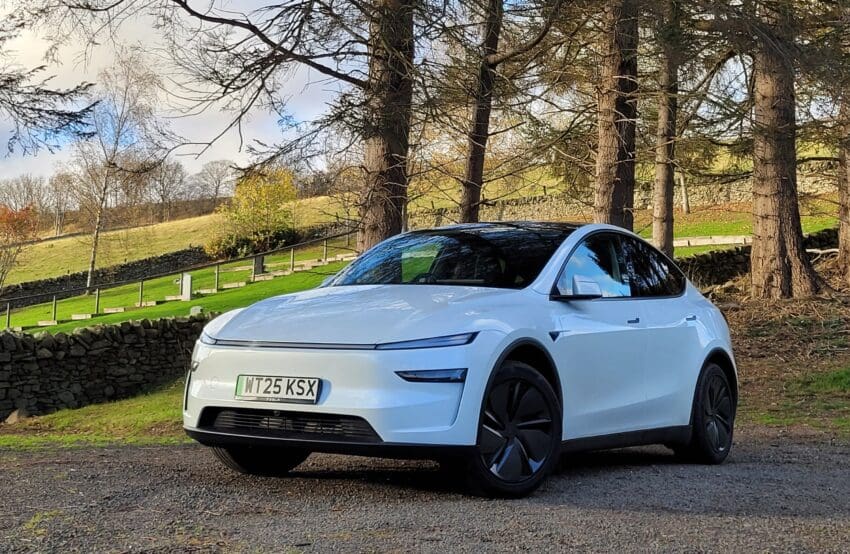
Thankfully, someone at Tesla agreed and the designers have done a proper job of this midlife facelift. The gawky lights and bulbous nose have been replaced with slimmer headlights and a full-width light bar housed in a far sharper, more defined face. It’s a similar story at the rear where new lights, a full-width light bar and a redesigned tailgate do a great job of giving the Model Y a cleaner, more modern look.
Sadly, the improvements don’t run to the interior, which is one of the bleakest prospects in motoring. Devoid of anything more than a steering wheel and touchscreen it’s a dull modernist affair where any fun or creativity has been exorcised. A lighter coloured interior might help elevate things but my test car’s black/chrome finish felt like climbing into a Silicon Valley tech bro’s coffin.
Positively, the Model Y has more space than said coffin. It’s perhaps not class-leading but there’s plenty of leg-, shoulder- and headroom all round, and comfortable, supportive seats that mean long distances with four adults on board aren’t an issue. There’s also an eight-inch screen in the rear that can access streaming services to keep younger passengers entertained.
Also in the interior’s favour, the build quality cannot be faulted. There’s none of the cheap flimsy plastics that used to blight Tesla interiors. Instead, all the touchpoints have a pleasing solidity and premium feel. Those touchpoints are limited because the Model Y has virtually no physical controls. There’s a steering wheel and a lone indicator stalk, plus window and door switches.

While you still get a stalk for your indicators (unlike the Model 3), functions like flashing your headlights or washing the windscreen are done via buttons on the steering wheel. It sounds odd, but works just fine.
I’m not so keen on having to adjust everything else via the 15.4-inch touchscreen. Whether it’s moving the mirrors, changing the wiper speed or even selecting drive or reverse, it’s all done via the screen. The screen itself is big, clear and super-responsive. There aren’t too many sub-menus either, but I still found the screeds of options annoying and the tiny shortcut icons frustrating to use on the move.
More annoying is the lack of an instrument display. Speed, range and everything else is shown on the central screen rather than in your line of sight, and a third of that screen is permanently taken up by the ADAS’ constantly flickering surround view system. I have eyes, I don’t need a screen showing CGI impressions of my surroundings.
On the ADAS front, the Model Y comes with the usual array of lane departure warnings etc that every rival features. The camera-based systems are less intrusive than most Chinese rivals but they’re still confused by British B-roads and bad weather, which caused persistent “system unavailable/camera blocked” warnings during my time with it.
Battery, motor and performance
Tesla is notoriously cagey about its battery specifics and flat-out refused to tell me the capacity on our Long Range RWD model. What Tesla will say is that the battery should provide up to 387 miles of range, which is still among the very best in its class, thanks to official efficiency of 4.37m/kWh.
Based on those numbers, I reckon that equates to an 88.5kWh battery, but maths was never my strong point.
I didn’t achieve the official efficiency but I did see a solid 3.7m/kWh on a tough week-long test cycle of short cold-start runs and longer high-speed excursions. That means a very usable real-world range of more than 300 miles.

Charging remains a strong point, too. A peak DC rate of 250kW isn’t as fast as some rivals but it’s still mighty impressive and backed up by simple plug-and-charge access to the excellent Supercharger network.
The long-range RWD car is powered by a single 295bhp motor which delivers a 0-60mph (not 62mph) time of 5.4 seconds. That’s certainly pacey enough performance for a mid-sized family SUV and the Tesla’s throttle is calibrated to give immediate shove.
There’s a 460bhp Performance version coming but in realistic day-to-day driving, I can’t see why you’d bother. This one feels plenty quick and responsive enough. As will all Teslas, there’s standard one-pedal which works neatly. The braking regen is well calibrated and works nicely with the well-modulated throttle pedal.
The Model Y’s steering is accurate and with decent weight but has an artificial feel. It feels (and sounds) like a belt-driven gaming wheel with slightly odd resistance. You can press on at the wheel of the Model Y with reasonable confidence but it’s not a setup that cries out to be driven enthusiastically. My notes are full of words like “stable” and “solid”.
Early versions of the Model Y got a kicking over their ride quality but Tesla has worked hard to improve this. It’s still not class-leading and there’s a touch of jitter over bad surfaces but, in general, the ride is perfectly comfortable while body movement remains well controlled.
Buried in the screen there are a couple of modes to adjust steering weight, throttle response and braking force. There are only two options for each, which at least means you don’t waste time messing about between modes – you’ll find the ones that you prefer and leave them.
Price and specification
The Model Y starts at £44,990 for the standard range rear-wheel-drive model and tops out at £61,990 for the Performance. In between there’s a long range all-wheel-drive (£51,990) and the tested long range rear-wheel-drive, which comes in at £48,990. It’s not cheap, but it is competitive with rivals.
Every model comes with 19-inch alloy wheels, adaptive LED lighting, keyless entry and start via the Tesla app, and a hands-free powered tailgate. Inside, front and rear seats are heated, there’s three-zone climate control, a panoramic sunroof, an eight-inch rear touchscreen with Netflix, plus the usual suite of ADAS including basic Autopilot – Tesla’s name for adaptive cruise and lane-keep assist.
Options are expensive and limited to paint (between £1,300 and £2,600), some 20-inch alloys (£2,100),Enhanced Autopilot (£3,400), and the flat-out fanciful “Full-Self Driving Capability” (£6,800).
Verdict
All told, the Tesla Model Y remains a hugely competent all-rounder.
Rivals have caught up, and done so quickly, so it’s perhaps not the stand-out segment leader it once was. However, it’s still spacious and comfortable with commendable performance, range and charging, and it’s keenly priced, too.
If you can live with the miserable interior aesthetic and lack of physical controls, there’s plenty to recommend.

Tesla Model Y Long Range RWD
- Price: £48,990
- Powertrain: Single-motor, rear-wheel-drive
- Battery: 88.5kWh (est)
- Power: 295bhp
- Torque: N/A
- Top speed: 125mph
- 0-62mph: 5.7 seconds
- Range: 387miles
- Consumption: 4.38m/kWh (WLTP)
- Charging: up to 250kW